SOLID-STATE BATTERY
Scrutiny Mounts Over Donut Lab's Solid State Battery Claims
Experts are questioning the feasibility of Donut Lab's announced solid-state battery, citing discrepancies with known scientific principles and ambitious performance promises.
- Read time
- 4 min read
- Word count
- 849 words
- Date
- Feb 8, 2026
Summarize with AI
Donut Lab recently introduced a solid-state battery with exceptional specifications, including rapid charging, high energy density, and extended cycle life. However, these claims have drawn skepticism from battery experts and enthusiasts. Investigations into the company's stated technology, which promises a production-ready, safe, and low-cost solution, reveal significant scientific inconsistencies. Despite claims of not using lithium or being capacitor-based, no known or emerging battery chemistry appears to match the company's multifaceted promises, leading to widespread concern about the feasibility and scientific validity of their breakthrough.
🌟 Non-members read here
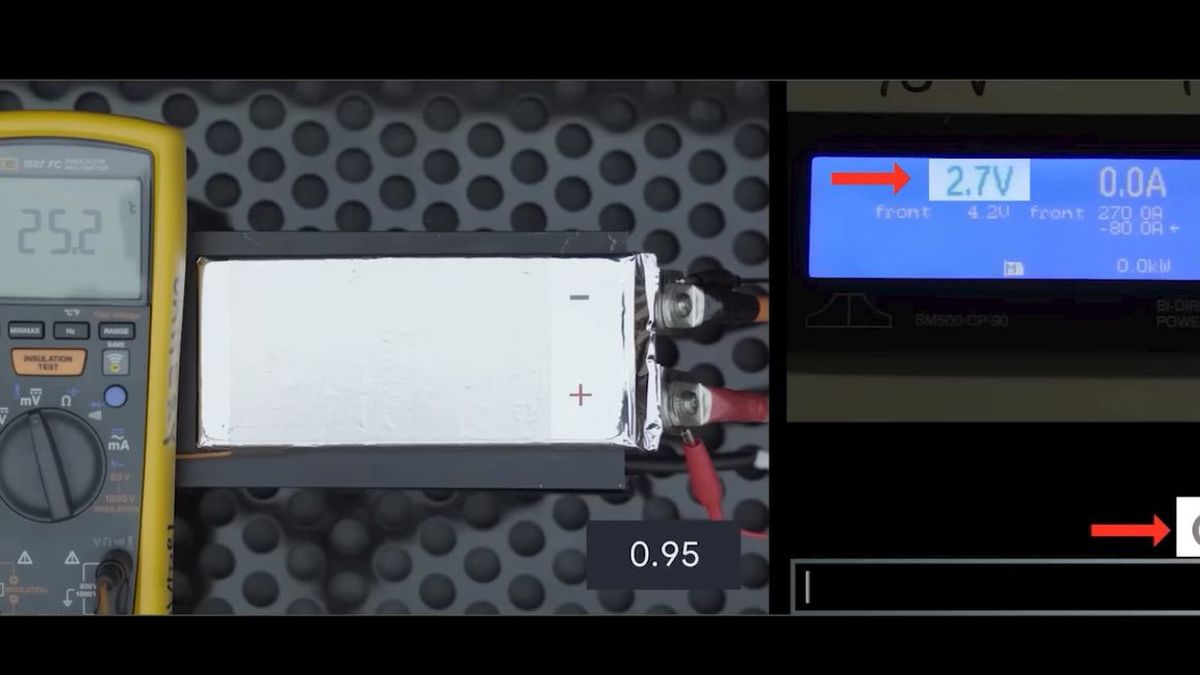
The world of energy storage recently buzzed with excitement following Donut Lab’s announcement of what it claimed to be the first production-ready solid-state battery. The company’s presentation included a list of specifications that appeared to fulfill every long-standing desire in battery technology. These ambitious claims, however, have not gone unchallenged.
Many experts and enthusiasts within the battery sector quickly voiced concerns about the feasibility and scientific grounding of Donut Lab’s asserted breakthrough. Following a demonstration at CES ‘26, independent researchers began to critically examine the company’s statements. The central question revolves around whether the claimed performance attributes align with established scientific principles and current advancements in battery chemistry.
Unpacking Donut Lab’s Extraordinary Claims
Donut Lab’s announced battery boasts an impressive array of features that, if true, would revolutionize numerous industries. Key among these are a full charge in under 10 minutes, an energy density of 400 watt-hours per kilogram, and a remarkable lifespan of 100,000 charge cycles. Furthermore, the company emphasized its safety, low production cost, and scalability, ticking every box on an ideal battery wish list.
These specifications, while highly desirable, originate solely from Donut Lab’s own assertions. The lack of independent verification or detailed scientific explanations for the underlying chemistry has fueled skepticism. Researchers are struggling to identify any known internal chemistry or configuration that could simultaneously deliver on all these promises. The company’s broader corporate promises to investors have also raised red flags, suggesting a need for heightened scrutiny.
The scientific community maintains a cautious approach to such announcements. Breakthroughs of this magnitude typically come with extensive peer-reviewed data and transparent explanations of the technology. Donut Lab’s approach has instead focused on headline-grabbing claims without providing the detailed scientific backing that would typically accompany such a significant advancement. This disparity between claims and scientific disclosure is a primary driver of the ongoing skepticism.
The Scientific Gauntlet: Evaluating Battery Chemistry Options
In an effort to understand the potential basis of Donut Lab’s battery, researchers considered several advanced battery technologies. One avenue explored was carbon nanotube-based supercapacitors, which can exhibit high capacity characteristics. While the material itself might achieve capacities near 418 watt-hours per kilogram, this metric applies only to the raw material. When integrated into a complete battery system, the overall energy density typically drops significantly, often to around 50 watt-hours per kilogram. This substantial reduction makes carbon nanotube supercapacitors an unlikely candidate to meet Donut Lab’s stated energy density for a complete battery unit.
Another potential chemistry considered was surface-redox sodium-ion technology utilizing titanium oxide. This particular chemistry is known for enabling rapid charging capabilities and offering high endurance over numerous cycles. Such properties align with some of Donut Lab’s claims regarding fast charging and cycle life. However, Donut Lab explicitly stated that their battery is neither capacitor-based nor does it employ lithium. These disclaimers effectively rule out many of the currently promising advanced battery chemistries, including those based on sodium-ion technology, further complicating efforts to identify a plausible scientific foundation for their product.
The challenge lies in finding a single battery architecture that combines ultra-fast charging, extremely high energy density, exceptional cycle life, and inherent safety, all while being low-cost and scalable. These multifaceted requirements present a formidable scientific hurdle. Current battery research, even in advanced fields like solid-state and alternative ion chemistries, typically involves trade-offs between these desirable characteristics. A significant increase in one area often comes at the expense of another, making Donut Lab’s comprehensive claims appear highly improbable without a fundamentally new scientific principle.
The Challenge of Unprecedented Specifications
The combination of “cheap” and “scalable” alongside the performance claims further compounds the skepticism surrounding Donut Lab’s announced battery. Achieving cutting-edge performance typically involves complex and often expensive manufacturing processes or rare materials. Bringing such technology to mass production at a low cost is an additional, formidable challenge. This trifecta of high performance, low cost, and high scalability is a long-standing goal in the battery industry, and achieving all three simultaneously would represent an unprecedented leap forward.
Without detailed information on the specific materials, electrode structures, and electrolyte used, it is nearly impossible for independent experts to validate Donut Lab’s claims. The lack of transparency has led many to conclude that, barring an undisclosed and truly revolutionary scientific breakthrough, the company’s battery claims appear inconsistent with known physics and chemistry. This situation often leads to concerns about over-promising, especially when significant investor capital is at stake.
While the battery industry eagerly awaits a truly transformative breakthrough, the scientific community emphasizes the importance of verifiable data and rigorous testing. Emerging chemistries, such as sodium-ion, are indeed making incremental progress, but they still face considerable challenges in matching or surpassing the overall performance of established lithium-ion technologies, particularly in terms of energy density for portable applications. Even lithium-titanate, while showing promise in certain aspects like fast charging and long cycle life, does not offer the dramatic power density increases that would render it superior to conventional lithium-ion for many common uses. The ongoing scrutiny of Donut Lab’s claims underscores a critical need for scientific rigor and transparency in the pursuit of next-generation energy storage solutions.