ARTIFICIAL INTELLIGENCE
AI Data Centers Seek Beyond Copper for Connectivity
AI data centers face a connectivity challenge as increasing GPU-to-GPU data rates push copper cables to their physical limits, prompting exploration of radio-frequency solutions.
- Read time
- 7 min read
- Word count
- 1,428 words
- Date
- Dec 27, 2025
Summarize with AI
The escalating demands of artificial intelligence models, particularly in data center scaling, are pushing traditional copper-based connectivity to its physical limits. As GPU-to-GPU data rates soar into the terabit-per-second realm, copper cables become shorter and thicker, complicating dense data center configurations. Startups like Point2 Technology and AttoTude are pioneering radio-based cable technologies, offering a compelling alternative that promises longer reach, reduced power consumption, and slimmer designs. This innovative approach aims to bridge the gap between costly optical fibers and constrained copper, potentially revolutionizing how AI systems communicate and scale.
🌟 Non-members read here
The rapid advancement of artificial intelligence (AI) models is placing unprecedented demands on data center infrastructure, particularly regarding how computational units communicate. This challenge is often viewed through two primary lenses: scaling out and scaling up. Each approach, while distinct, highlights a critical need for more efficient and robust connectivity solutions.
Scaling out involves connecting a greater number of AI computers to collaboratively address large-scale problems. This usually relies on photonic chips and optical fiber, which can transmit data across hundreds or even thousands of meters. Conversely, scaling up focuses on maximizing the number of graphics processing units (GPUs) within a single computer, enabling them to function as one colossal GPU for faster processing of complex tasks. This method typically uses shorter, less expensive copper cables, often spanning just a few meters.
However, the relentless increase in GPU-to-GPU data rates, essential for creating more powerful computing systems, is rapidly encountering the inherent physical limitations of copper. As bandwidth requirements approach the terabit-per-second range, the physics dictates that copper cables must become shorter and thicker. This presents a significant hurdle for data centers striving for higher density and efficiency, especially with major hardware companies planning substantial increases in the number of GPUs per system. The industry refers to this impending challenge as the “copper cliff.”
In response, innovators are exploring solutions that extend copper’s capabilities or integrate high-performance optical fiber closer to the GPUs. Two startups, Point2 Technology and AttoTude, are championing an alternative: radio-based cables. They propose a technology that combines the cost-effectiveness and reliability of copper with the slim design and extended reach of optical fiber, promising to meet the demands of future AI systems.
Radio-Based Connectivity Emerges
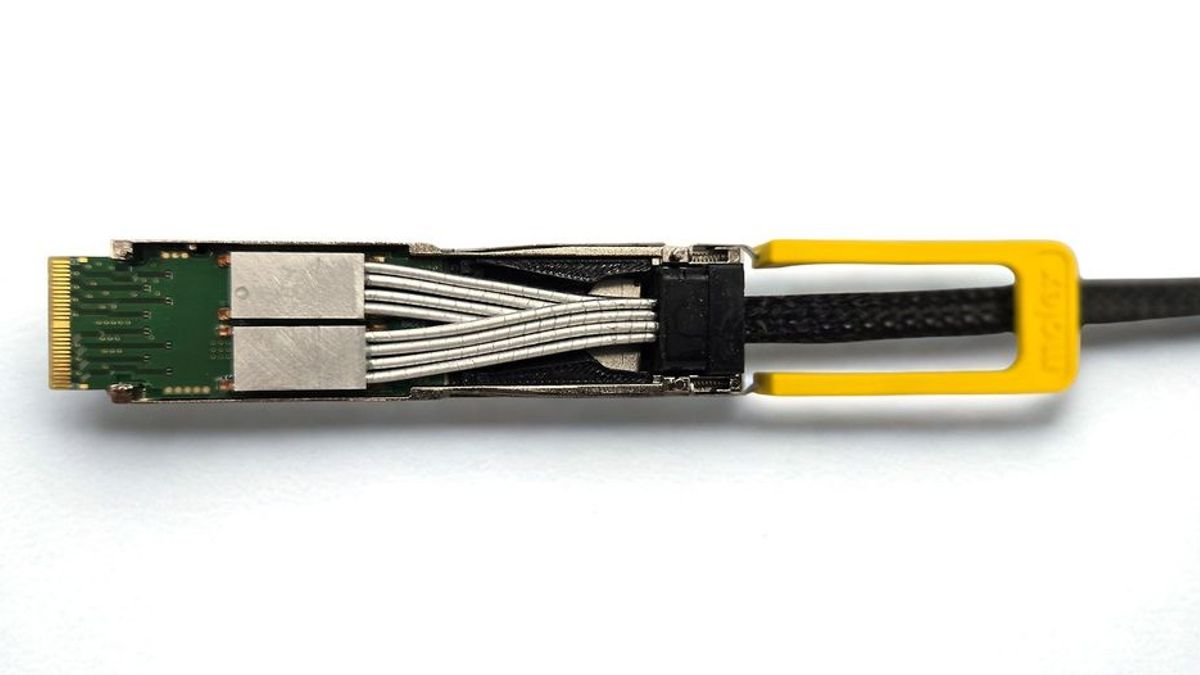
Later this year, Point2 Technology plans to commence manufacturing chips for a 1.6-terabit-per-second cable, featuring eight slender polymer waveguides. Each waveguide will be capable of transmitting data at 448 gigabits per second, utilizing two distinct frequencies: 90 gigahertz and 225 GHz. These systems incorporate plug-in modules at each end, which convert electronic data bits into modulated radio waves and vice versa. AttoTude is pursuing a similar approach, but at even higher terahertz frequencies and with a different type of flexible, thin cable.
Both companies assert that their radio-based technologies can significantly surpass copper in terms of reach, spanning 10 to 20 meters without substantial signal loss. This distance is more than sufficient to support the large-scale GPU configurations anticipated by leading AI hardware manufacturers. Point2, for instance, highlights that its system consumes merely one-third the power of optical solutions, costs one-third as much, and delivers latency that can be as low as one-thousandth of optical technology.
Advocates for radio technology also emphasize its superior reliability and ease of manufacturing compared to optical alternatives. They suggest that these advantages could enable radio-based solutions to integrate low-energy processor-to-processor connections directly with GPUs. Such integration would effectively reduce the reliance on copper even within the printed circuit board, further enhancing efficiency and reducing system complexity. This shift represents a significant evolution in data center interconnectivity, moving beyond the traditional constraints of established technologies.
The Limits of Copper and the Promise of Radio
Copper, while historically reliable for short-distance data transmission, faces significant challenges as data rates climb. At high frequencies, copper conductors exhibit what is known as the “skin effect.” This phenomenon occurs when rapidly changing electrical currents induce a magnetic field that concentrates the current flow at the wire’s outer edge, or “skin,” rather than uniformly throughout the conductor. This effectively increases resistance, necessitating wider wires and more power to maintain signal integrity, which directly contradicts the need for dense, compact connections in advanced data centers.
To mitigate the skin effect and other signal degradation issues, the industry has developed specialized copper cables incorporating active electronics, known as active electrical cables (AECs). These cables feature terminating chips, called retimers, at each end. Retimers are designed to clean up and retransmit data and clock signals, effectively extending the distance over which copper can reliably transmit data. For example, some AECs can deliver 800 gigabits per second over distances of up to 7 meters. This extended reach is becoming crucial as computing systems scale to hundreds of GPUs, potentially spanning multiple equipment racks.
Despite these advancements, the physical limits of copper will eventually be reached. This looming “copper cliff” is precisely where Point2 and AttoTude believe their radio-based solutions will become indispensable. Their argument is that radio frequencies offer a fundamentally different approach to signal transmission, sidestepping many of the issues that plague copper at extreme data rates. By moving to millimeter-wave and terahertz frequencies, these startups aim to unlock new possibilities for high-speed, low-power, and compact data center interconnects, preparing for a future where traditional copper falls short.
AttoTude’s development, for example, originated from extensive research into photonics and a desire to overcome its inherent weaknesses: high power consumption, sensitivity to temperature, and complex, micrometer-precision manufacturing requirements. Founder and CEO Dave Welch, drawing from decades of experience in optical telecommunications, recognized the greater reliability of electronic systems. He sought the highest achievable frequency purely with electronics, leading to the exploration of the terahertz regime (300 to 3,000 GHz).
AttoTude’s system concept includes a digital component for GPU interfacing, a terahertz-frequency generator, and a mixer to encode data onto the terahertz signal. An antenna then channels this signal into a narrow, flexible waveguide. Early prototypes of these waveguides, made from a dielectric core surrounded by cladding, demonstrated extremely low signal loss, promising data transmission over distances of up to 20 meters. This range is considered ideal for scaling up within data centers, offering a compelling alternative to both copper and traditional optical fiber.
Market Adoption and Future Prospects
Point2 Technology, with nine years in operation and $55 million in venture funding, is well-positioned to introduce its radio-based solutions to the data center market. Strategic backing from major cable and connector manufacturer Molex underscores the commercial viability of Point2’s e-Tube cable technology. The fact that Molex can manufacture these cables using existing production lines, along with a partnership with Foxconn Interconnect Technology, provides significant leverage. This industry support is a key factor for hyperscale data center operators considering new connectivity solutions.
Point2’s e-Tube cable, known as an active radio cable (ARC), consists of a single silicon chip at each end. This chip converts incoming digital data into modulated millimeter-wave frequencies, which are then radiated by an antenna into the waveguide. The waveguide itself comprises a plastic core, metal cladding, and a metal shield. An ARC cable, designed for 1.6 terabits per second, integrates eight e-Tube cores. At just 8.1 millimeters in diameter, this cable occupies half the volume of a comparable active electrical copper cable, offering substantial space savings in dense data center environments. Furthermore, a notable advantage of operating at radio frequencies is that the chips can be produced using standard silicon foundry processes, such as 28-nanometer CMOS technology, which is a mature and cost-effective manufacturing process.
Despite the promise of radio frequency technology, the data center industry has a deeply ingrained reliance on copper. Data center operators typically exhaust all passive copper options before considering alternatives. The widespread adoption of liquid cooling in data centers, for instance, is partially driven by the desire to continue using passive copper by enabling higher component densities that would otherwise overheat with air cooling. However, radio-based ARCs could alleviate the need for such extreme cooling measures by allowing for a more distributed arrangement of GPUs while still achieving high-speed, scaled-up performance.
Both Point2 and AttoTude are also pursuing the integration of their radio technology directly into GPU packages. This “co-packaged optics” approach, where transceivers are placed within micrometers of the processor, is already being explored by companies like Nvidia and Broadcom for network-switch chips. The ultimate goal is to extend this tight integration all the way to the GPU itself. In this scenario, radio frequency technology may hold an advantage over optical solutions. Attaching optical fibers to photonic chips requires extremely precise alignment due to the short wavelength of infrared laser light. In contrast, millimeter-wave and terahertz signals have much longer wavelengths, making waveguide attachment less demanding in terms of precision. This simplification in manufacturing could make co-packaged radio transceivers a highly attractive and achievable “real prize” for future high-performance computing.
The evolving landscape of AI data centers necessitates a departure from traditional connectivity paradigms. As copper reaches its physical limits, radio-based solutions offer a compelling blend of performance, cost-effectiveness, and reliability. This innovative shift could redefine how high-speed data is transmitted and processed, ushering in a new era of efficiency and capability for AI infrastructure.