NASA
NASA Leverages AI for Enhanced Mars Rover Autonomy
NASA's Perseverance rover recently demonstrated advanced AI navigation, traveling 456 meters autonomously by using AI-generated waypoints, significantly advancing space exploration efficiency.
- Read time
- 6 min read
- Word count
- 1,312 words
- Date
- Feb 15, 2026
Summarize with AI
In a recent advancement, NASA's Perseverance rover utilized artificial intelligence to autonomously navigate the Martian surface, completing two drives totaling 456 meters without direct human intervention. This demonstration involved an AI model analyzing orbital images and elevation data to identify hazards and plot safe routes. The successful integration of AI, which is rooted in Anthropic's Claude AI, signifies a crucial step toward enhancing rover autonomy, reducing the impact of communication delays, and ultimately increasing the efficiency and scientific return of deep space missions.
🌟 Non-members read here
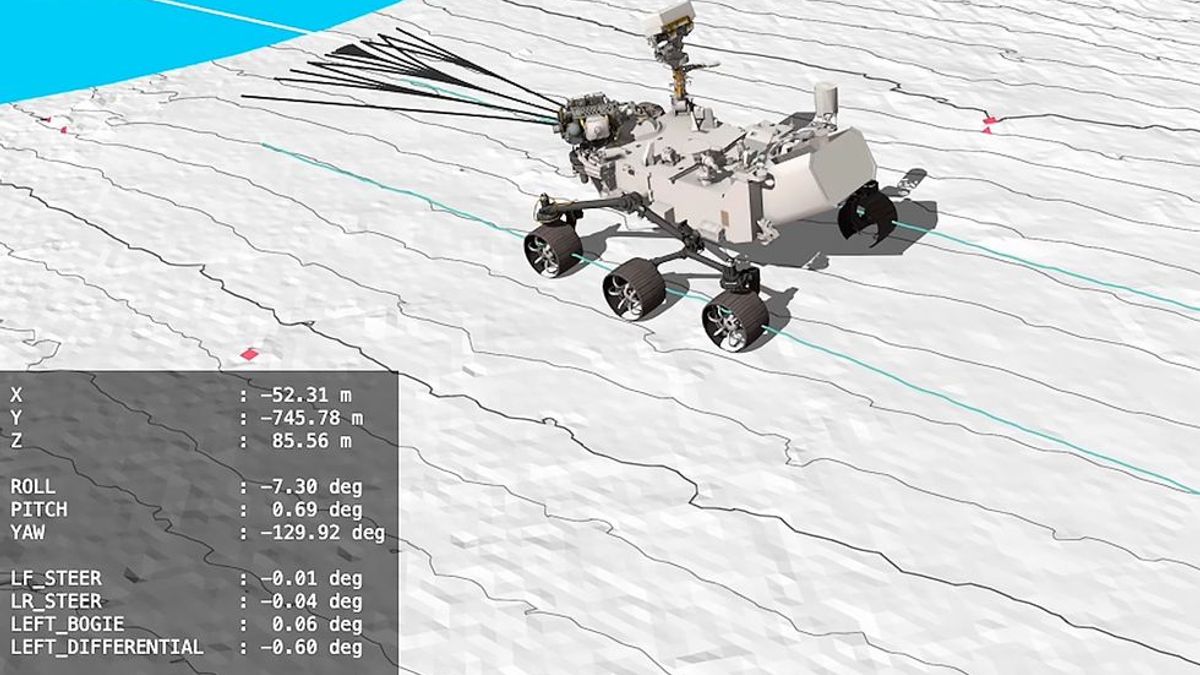
NASA recently demonstrated a significant leap in autonomous surface rover technology, with the Perseverance rover on Mars utilizing artificial intelligence to independently generate its navigation waypoints. This groundbreaking demonstration in December saw the rover traverse a total of 456 meters over two separate days, entirely without human control. This marks a crucial step toward more self-reliant exploration in deep space.
Jared Isaacman, NASA Administrator, highlighted the importance of this development. He noted that such autonomous technologies are vital for increasing mission efficiency, navigating challenging terrains, and maximizing scientific returns, especially as exploration distances from Earth grow. This careful and responsible application of new technology reflects a strategic advancement in space operations. The success underscores NASA’s commitment to pioneering innovative solutions for future missions.
Overcoming Martian Distances with AI
The vast distance to Mars presents unique challenges for rover operations, primarily due to a substantial communication delay. A round trip signal between Earth and Mars can take approximately 25 minutes, meaning rovers must operate independently for short periods. This inherent delay heavily influences the route-planning process for mission controllers on Earth.
Traditionally, rover drivers analyze detailed images and elevation data to program a series of waypoints, typically not exceeding 100 meters apart. These meticulously planned routes are then transmitted via NASA’s Deep Space Network to Martian orbiters, which relay the instructions to Perseverance. While Perseverance has a backup capability to receive direct communications from the Deep Space Network, the data transfer rate is considerably slower. This established protocol underscores the necessity for robust autonomous capabilities to enhance mission progress and efficiency.
The integration of artificial intelligence into this process introduces a new paradigm for Martian navigation. By enabling the rover to generate its own waypoints, NASA significantly mitigates the constraints imposed by communication lag. This shift reduces the dependency on constant Earth-based input, allowing Perseverance to cover more ground and perform scientific investigations with greater agility. Such advancements are critical for expanding the scope and speed of exploration on other celestial bodies.
The ability of an AI to interpret complex environmental data and make real-time navigational decisions is transformative. It not only accelerates exploration but also enhances the safety of the rover by proactively identifying and avoiding potential hazards. This ongoing development highlights a strategic move towards a future where deep space missions can operate with unprecedented levels of independence and effectiveness, pushing the boundaries of scientific discovery. The ultimate goal is to enable rovers to undertake longer, more complex traverses, thereby unlocking new opportunities for scientific investigation.
Artificial Intelligence Revolutionizes Rover Navigation
In a pivotal demonstration, the AI model employed for Perseverance’s autonomous navigation analyzed intricate orbital images from the Mars Reconnaissance Orbiter’s HiRISE camera, alongside detailed digital elevation models. This sophisticated AI, built upon the foundation of Anthropic’s Claude AI, adeptly identified critical hazards on the Martian surface. These included treacherous sand traps, expansive boulder fields, exposed bedrock formations, and various rocky outcrops that could impede the rover’s progress or pose a risk.
Following its comprehensive analysis, the AI generated an optimized path, precisely defined by a sequence of waypoints designed to circumvent all identified obstacles. With this AI-crafted plan in hand, Perseverance’s advanced auto-navigation system seamlessly took over. This system boasts greater autonomy than its predecessors, allowing it to process both images and pre-programmed driving plans concurrently while in motion. This simultaneous processing capability significantly enhances the rover’s efficiency and responsiveness on the unpredictable Martian terrain.
An essential preliminary step before transmitting these AI-generated waypoints to Perseverance involved rigorous testing on Earth. NASA’s Jet Propulsion Laboratory maintains a meticulously engineered “twin” of Perseverance, known as the “Vehicle System Test Bed,” or VSTB. This engineering model resides within JPL’s Mars Yard, a dedicated testing facility. Such terrestrial replicas are standard practice for Mars missions, with JPL also possessing one for the Curiosity rover. The VSTB allows the engineering team to troubleshoot potential issues and validate new functionalities, like the AI-driven navigation, in a controlled environment before deployment on Mars.
Vandi Verma, a distinguished space roboticist at JPL and a key member of the Perseverance engineering team, emphasized the profound impact of generative AI. She explained that the fundamental elements of this technology are demonstrating immense promise in streamlining the core pillars of autonomous off-planet driving. These pillars encompass perception, which involves accurately discerning features like rocks and ripples; localization, or precisely determining the rover’s position; and planning and control, which entails deciding and executing the safest possible path. Verma envisions a future where generative AI and other intelligent tools will empower surface rovers to undertake kilometer-scale drives with minimal operator intervention. Furthermore, these advanced systems will be capable of autonomously flagging intriguing surface features for the science team by meticulously analyzing vast volumes of rover imagery. This approach promises to significantly enhance the pace and scope of scientific discovery.
Expanding Horizons: The Future of AI in Space Exploration
Artificial intelligence is becoming increasingly integrated into various aspects of daily life, extending its reach into areas where its application might not have been immediately obvious. However, NASA’s embrace of AI for space exploration is not a superficial trend; it stems from a long-standing necessity. The agency has been diligently developing automatic navigation systems for its rovers for years, driven by the unique challenges of operating in distant and autonomous environments. In fact, Perseverance primarily relies on its sophisticated self-driving autonomous navigation system for its daily operations.
One of the persistent challenges preventing fully autonomous driving is the inherent uncertainty that accumulates as a rover operates without human oversight. The longer the rover travels, the greater the uncertainty becomes regarding its precise position on the Martian surface. The current solution involves re-localizing the rover on its map, a task traditionally performed by human operators. This re-localization process is time-consuming, requiring a complete communication cycle between Earth and Mars, which ultimately limits how far Perseverance can travel without human intervention.
NASA’s Jet Propulsion Laboratory is actively researching methods for Perseverance to utilize AI for re-localization. The primary hurdle in this endeavor is effectively matching high-resolution orbital images with the rover’s ground-level perspectives. Experts anticipate that AI will prove exceptionally proficient at this intricate task, given its capabilities in pattern recognition and data correlation. This development promises to significantly enhance the rover’s ability to maintain an accurate understanding of its position, thereby extending its autonomous operational range.
The role of AI in planetary exploration is unequivocally set to expand dramatically. Future Mars rovers are likely to exhibit significantly different architectures, incorporating more advanced autonomous navigation capabilities and other AI-driven features. Early concepts already envision scenarios where a swarm of AI-controlled flying drones, deployed by a central rover, could collectively explore and map vast Martian territories. These drone swarms would leverage AI to collaborate and operate autonomously, vastly increasing the exploratory reach and efficiency of missions.
Beyond Mars, AI is poised to play a critical role in other ambitious NASA missions, such as the Dragonfly mission to Saturn’s moon Titan. On Titan, AI will be extensively utilized not only for the autonomous navigation of the rotorcraft as it flies across the moon’s surface but also for intelligent data curation. This involves the AI sifting through vast amounts of gathered data to identify and prioritize the most scientifically relevant findings, thereby maximizing the mission’s scientific return.
Matt Wallace, manager of JPL’s Exploration Systems Office, articulated a compelling vision for the future. He envisions intelligent systems operating not only on Earth but also as embedded “edge applications” within rovers, helicopters, drones, and other surface elements across the solar system. These AI systems, trained with the collective wisdom of NASA engineers, scientists, and astronauts, represent a truly transformative technology. Wallace emphasized that such game-changing innovations are essential for establishing the foundational infrastructure and robust systems required for a permanent human presence on the Moon and for extending humanity’s reach to Mars and beyond, pushing the boundaries of cosmic exploration.