ROBOTICS
Robots Achieve Breakthrough in Rapid Task Learning
Scientists have achieved a significant milestone, enabling a robot to learn 1,000 distinct physical tasks in a single day, ushering in new possibilities for automation.
- Read time
- 4 min read
- Word count
- 953 words
- Date
- Jan 4, 2026
Summarize with AI
A groundbreaking achievement in robotics has seen a single robot successfully learn 1,000 diverse physical tasks within 24 hours. This research, published in Science Robotics, signifies a major leap in artificial intelligence and machine learning by enabling robots to acquire complex skills from minimal human demonstrations. This advancement moves robotics closer to human-like learning, potentially revolutionizing industries from manufacturing and healthcare to logistics and home automation. The ability for robots to generalize and adapt to new situations rather than merely repeating programmed actions could transform the future of human-robot interaction.
🌟 Non-members read here
Robots Master 1,000 Tasks in a Single Day
A recent scientific breakthrough in robotics has dramatically advanced how machines acquire new skills. Researchers have successfully taught a robot to perform 1,000 different physical tasks in a single day, using only one demonstration for each task. This milestone represents a significant step forward, moving past the common perception of robots as rigid machines capable of only repetitive, pre-programmed motions. The findings, detailed in a report published in Science Robotics, indicate a paradigm shift in the field of artificial intelligence and robotics.
This innovative research addresses a longstanding challenge in robotics: the inefficiency of teaching machines new physical actions. Historically, even simple tasks required extensive programming and numerous demonstrations, often numbering in the hundreds or thousands. This labor-intensive process has limited robots primarily to controlled industrial environments where they perform the same motion repeatedly. The new methodology aims to bridge the gap between human and robotic learning, which has constrained the practical applications of robotics for decades.
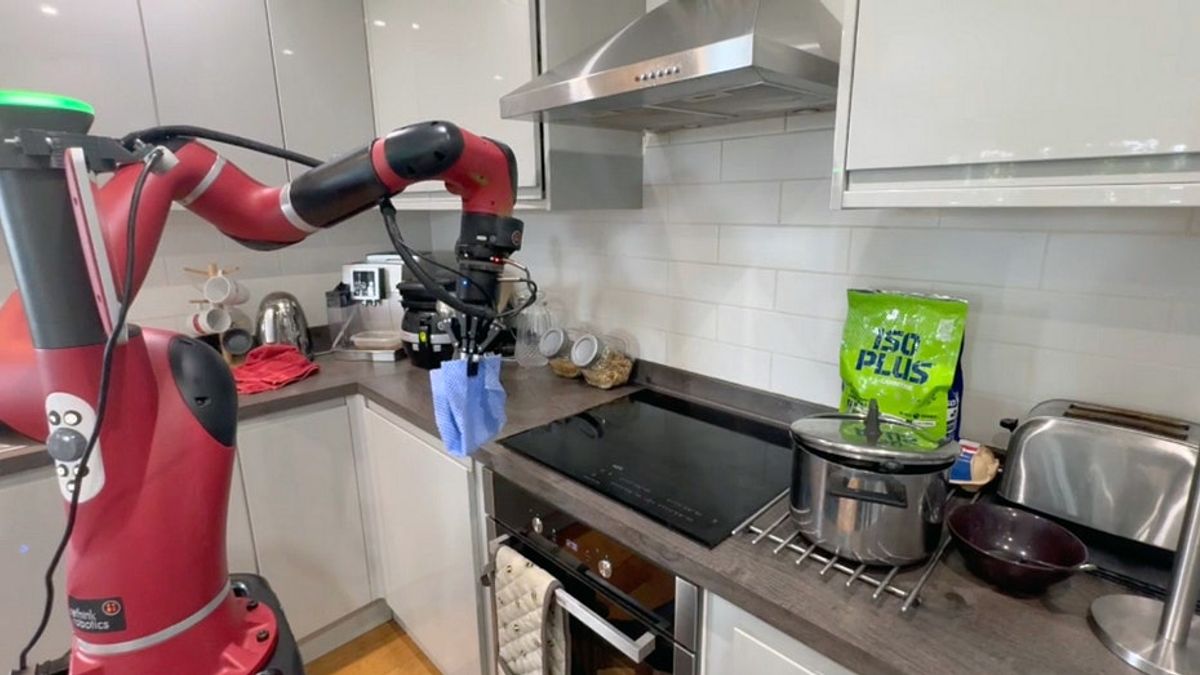
The range of tasks the robot learned was remarkably diverse, including precise placements, intricate folding, object insertions, various gripping techniques, and general object manipulation. Unlike many laboratory demonstrations, these tasks were executed in a real-world environment using everyday objects, contending with the complexities and variables present outside of perfectly controlled conditions. This real-world application underscores the robustness and adaptability of the new learning system. The ability of the robot to generalize and apply learned knowledge to novel objects it had never encountered before is a crucial aspect of this advancement, moving beyond mere rote memorization.
A New Approach to Robot Learning
The core of this breakthrough lies in a more intelligent method for robots to learn from human demonstrations. Instead of attempting to replicate entire complex movements, the system deconstructs each task into more manageable phases. One phase focuses on the precise alignment with an object, ensuring the robot positions itself correctly, while another phase manages the actual interaction with the object. This modular decomposition simplifies the learning process for the machine.
This innovative approach is powered by artificial intelligence, specifically a technique known as imitation learning. Imitation learning enables robots to acquire physical skills by observing and mimicking human actions. By breaking down tasks and leveraging AI, the robot can more effectively interpret and internalize the demonstrated movements. The system’s ability to learn from a single demonstration per task marks a significant departure from previous methods that demanded vast datasets and extensive fine-tuning by engineers.
The research introduces a method called Multi-Task Trajectory Transfer, which allows the robot to reuse and apply knowledge gained from previously learned tasks to new ones. This retrieval-based strategy prevents the system from starting from scratch with each new task, enabling it to build upon its existing knowledge base. This generalization capability is vital for robots to adapt to dynamic environments and perform a wide array of functions without continuous human intervention. The researchers successfully trained a physical robot arm on 1,000 distinct daily tasks in less than 24 hours of human demonstration time, proving the efficiency of this novel learning paradigm.
Real-World Implications and Future Possibilities
The fact that this extensive training occurred in a real-world setting, complete with actual objects, potential errors, and physical constraints, is paramount to the significance of this research. Many robotics advancements appear impressive in simulation but often struggle when introduced to less predictable, real-life conditions. The rigorous testing involving thousands of real-world trials demonstrates the system’s practical viability. This level of adaptability and generalization has long been the missing link in developing truly versatile robots.
This research effectively addresses one of the most significant bottlenecks in robotic development: the inefficient process of teaching robots new actions. By strategically decomposing tasks and enabling the reuse of learned knowledge, the new system has achieved a substantial improvement in data efficiency. This leap forward suggests that the vision of a robot-assisted future, often confined to science fiction, may be closer to reality than previously anticipated. The implications of faster, more efficient learning for robots are far-reaching.
If robots require less data and programming to learn, their deployment becomes more cost-effective and flexible. This increased flexibility opens doors for robots to operate outside the tightly controlled environments of industrial factories. In the long term, this could lead to the development of home robots capable of learning new tasks from simple demonstrations, eliminating the need for specialized coding or extensive training. Beyond domestic applications, this technology holds major potential for transforming sectors such as healthcare, logistics, and manufacturing, where adaptable automation could significantly enhance efficiency and capabilities.
Shifting the Paradigm of AI and Robotics
This breakthrough also signals a broader shift within the field of artificial intelligence. The focus is increasingly moving away from systems designed for narrow, specialized functions toward more versatile systems that can learn in ways that mirror human cognition. While this does not imply robots are becoming “smarter” than humans, it indicates a progression toward machines that can operate more closely to how humans naturally acquire and apply knowledge in daily life. This evolution makes AI systems more practical and accessible for a wider range of applications.
While the ability of robots to learn 1,000 tasks in a single day does not mean humanoid helpers will be ubiquitous in homes tomorrow, it undeniably represents substantial progress on a problem that has hindered robotic development for decades. The fundamental conversation about robotics changes when machines begin to learn in a manner more akin to humans. The question shifts from what robots can merely repeat to what new challenges they can adapt to next. This pivotal change is certainly worth close attention, as it reshapes expectations for the future of human-robot interaction and automated systems across various industries.