MAGNETOHYDRODYNAMIC DRIVE
Yamato-1: A Look at the Pioneering MHD Propulsion Ship
Explore the innovative magnetohydrodynamic propulsion technology, its historical significance with the Yamato-1, and the challenges limiting its widespread adoption.
- Read time
- 4 min read
- Word count
- 913 words
- Date
- Jan 10, 2026
Summarize with AI
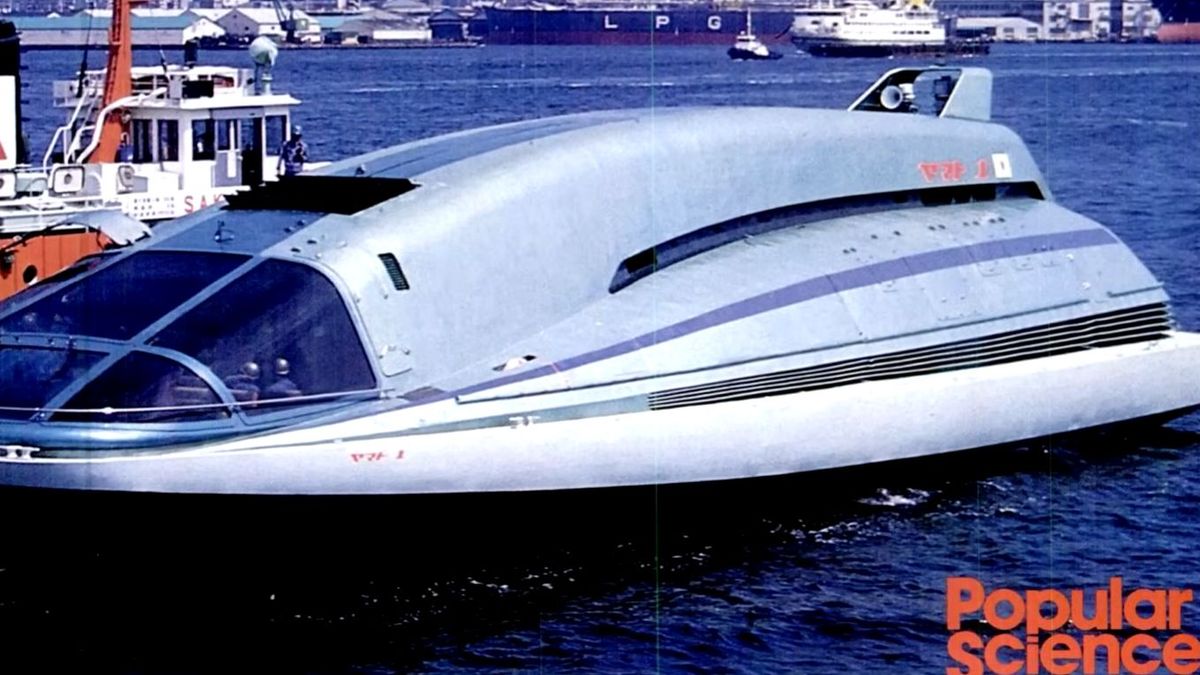
While propellers dominate maritime propulsion, alternative methods like magnetohydrodynamic drives have emerged. The Japanese Yamato-1, launched in 1992, stands as the only full-scale prototype to carry humans using this innovative technology. Relying on the Lorentz force and superconducting coils, the Yamato-1 demonstrated the potential of propulsion without moving parts. Despite its advanced concept, efficiency limitations and the inherent conductivity of seawater posed significant challenges, preventing its widespread commercial application. The vessel now holds a place in engineering history as a remarkable, albeit ultimately impractical, experiment in ship propulsion.
🌟 Non-members read here
The Dawn of Magnetohydrodynamic Propulsion
For centuries, the humble propeller has been the workhorse of marine propulsion, driving ships across oceans and rivers. Yet, the history of naval engineering is also punctuated by innovative attempts to break free from conventional methods. Among the most intriguing of these is the magnetohydrodynamic drive (MHDD), a concept that promises silent, vibration-free propulsion without any moving parts.
This revolutionary technology harnesses the Lorentz force, using magnetic fields to accelerate a conductive fluid. In the context of a ship, this fluid is the seawater itself, which, due to its dissolved salts, possesses sufficient electrical conductivity to interact with magnetic fields. The vision of a ship gliding silently, pushed by an invisible force, captivated engineers and scientists for decades.
The Genesis of the Yamato-1
The most ambitious realization of this futuristic concept came with the Japanese vessel, the Yamato-1. Launched in 1992, this full-scale prototype represented a monumental leap in naval technology, becoming the world’s first ship to carry humans using magnetohydrodynamic propulsion. It was a testament to human ingenuity and a bold experiment in redefining maritime travel.
The Yamato-1 was not merely a theoretical exercise; it was a tangible demonstration of principles previously confined to laboratories. Its brief operational life and subsequent retirement to the Kobe Maritime Museum, before being scrapped in 2016, underscore the complex journey from scientific concept to practical application. The vessel remains a landmark in the annals of propulsion innovation.
Understanding MHDD Technology
Magnetohydrodynamic drives operate on a principle that is deceptively simple: applying a magnetic field to a conductive fluid induces a force that can propel the fluid, and by extension, the vessel containing it. This fundamental concept eliminates the need for mechanical components like propellers, shafts, and gearboxes, promising a future of quieter and potentially more durable propulsion systems. However, the practical implementation involves significant engineering challenges, particularly concerning efficiency and power requirements.
The Yamato-1 utilized a specific type of MHDD known as an inductive drive. This system differs from conductive drives, which rely on direct electrical contact with the fluid through electrodes. Instead, inductive drives generate thrust using powerful magnetic fields, interacting with the charged ions present in seawater. This method avoids some of the issues associated with electrode corrosion and fouling, but introduces other complexities.
Superconducting Coils and Lorentz Force
At the heart of the Yamato-1’s propulsion system were liquid helium-cooled, superconducting coils. These advanced components were crucial for generating the extremely strong magnetic fields necessary to interact effectively with seawater. Superconductivity allowed for the creation of intense magnetic fields with minimal energy loss, a critical factor in any high-power electromagnetic application.
When these powerful magnetic fields interacted with the conductive seawater, the Lorentz force came into play. This fundamental electromagnetic force dictates that a charged particle moving through a magnetic field, or a current-carrying conductor within a magnetic field, experiences a force perpendicular to both the direction of the current and the magnetic field. In the Yamato-1, this force pushed the seawater, generating the thrust required to move the ship forward. The direction of this thrust could be understood through the well-known right-hand rule, a mnemonic used in physics to determine the direction of force, current, or magnetic field. This elegant interplay of physics allowed the vessel to achieve propulsion without any traditional mechanical movers.
Challenges and Future Prospects
Despite its groundbreaking nature, the Yamato-1 faced significant hurdles that ultimately limited its practical viability. One of the most prominent challenges was its efficiency. The vessel achieved a working efficiency of approximately 15 percent, a figure substantially lower than conventional propeller-based systems. This low efficiency meant that a disproportionately large amount of energy was required to generate even modest thrust, making it an impractical choice for commercial shipping.
Furthermore, the Yamato-1 achieved a top speed of only about 15 kilometers per hour, or 8 knots. While impressive for a proof-of-concept vessel, this speed is far too slow for most modern maritime applications, which demand much higher transit speeds for efficiency and competitiveness. The combination of low efficiency and limited speed presented a formidable barrier to widespread adoption of this technology.
The Nature of Seawater and Research Continuation
A core problem lies in the very medium being used for propulsion: seawater. While seawater is conductive due to dissolved salts, its conductivity is not exceptionally high. This inherent property limits the efficiency with which the magnetic fields can interact with the water to generate thrust. Enhancing the conductivity, for instance by adding more ions, is not a feasible option for open-ocean vessels, as it would be environmentally unsound and economically prohibitive.
Consequently, despite continuous research into magnetohydrodynamic drives, practical applications for large-scale maritime propulsion remain elusive. The Yamato-1, much like other experimental vehicles such as the Lun-class ekranoplan, a ground-effect vehicle, is likely to be remembered as a fascinating but ultimately niche development in transportation history. These pioneering projects push the boundaries of engineering, revealing both immense potential and the stubborn realities of physics and economics.
Nevertheless, the principles demonstrated by the Yamato-1 continue to inspire researchers. While full-scale ship propulsion remains a distant goal, smaller-scale applications or specialized uses where silent operation or the absence of moving parts is paramount could still emerge. The legacy of the Yamato-1 underscores the ongoing human quest for innovative solutions, even when those solutions prove challenging to integrate into mainstream technology. The journey of exploration itself often yields invaluable insights, paving the way for future breakthroughs, even if the initial destination remains out of reach.