QUANTUM COMPUTING
Universal Quantum Reveals iQPU Integrated Processing Unit
Universal Quantum launches the iQPU, a trapped-ion quantum processor designed to integrate control electronics and modular links for industrial scaling.
- Read time
- 5 min read
- Word count
- 1,153 words
- Date
- Nov 3, 2026
- Key Takeaways:
- Universal Quantum released the iQPU which features an active compute area exceeding 400 square millimeters.
- The company secured 67 million euros in contracts with the German Aerospace Center to build two scalable quantum computers.
- The iQPU is manufactured on a standard 200 millimeter semiconductor foundry line to ensure repeatable production.
- Universal Quantum recently closed a 100 million dollar Series A funding round to support its global scaling efforts.
🌟 Non-members read here
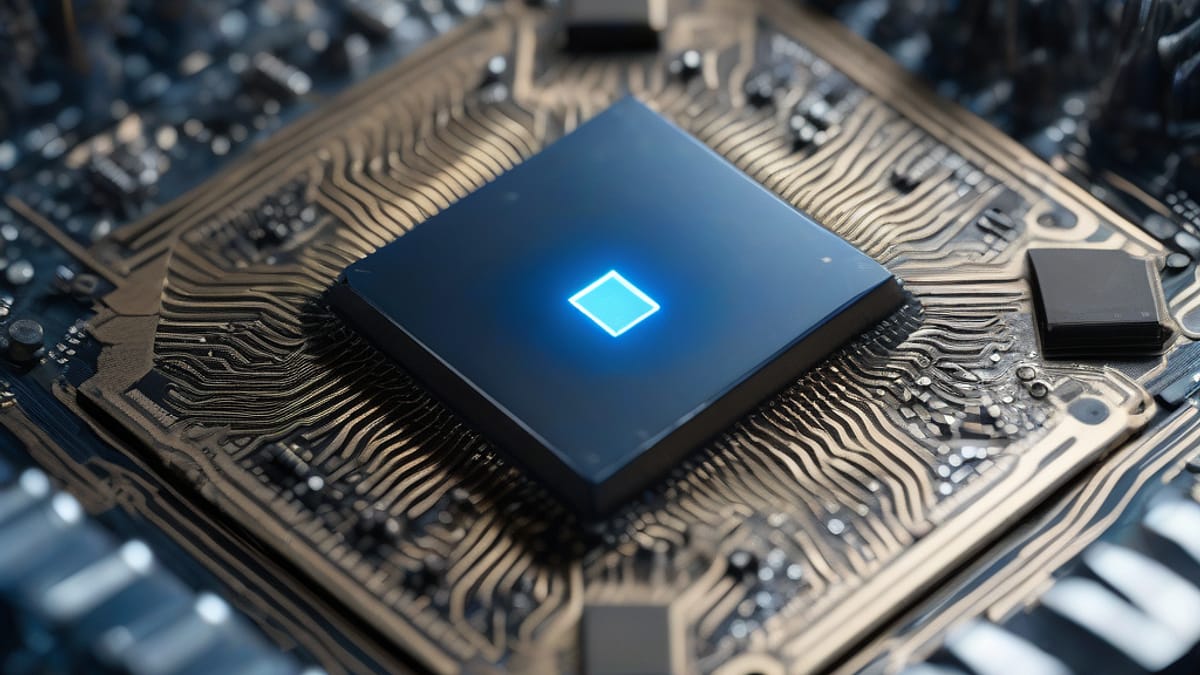
Universal Quantum announced the launch of the iQPU, a trapped-ion quantum processing unit designed to make quantum hardware practical to manufacture and scale. This integrated chip combines a massive compute surface with on-chip control technology and modular interconnects. It represents a significant shift toward commercial viability for quantum systems by addressing long-standing engineering bottlenecks.
Integrated Architecture for Mass Production
The development of the iQPU marks a departure from traditional quantum hardware design, which often relies on bespoke laboratory setups that are difficult to replicate. Universal Quantum focused on creating a system that is scalable from its inception. By integrating control electronics directly into the chip, the company reduces the external hardware requirements that typically plague quantum systems as they grow in qubit count.
This unit features a Quantum Charge-Coupled Device architecture. This design allows ions to move across the chip surface. Such movement enables flexible, long-range connections between qubits. Unlike architectures where qubits remain in fixed locations, this mobile approach helps decrease the total number of qubits needed to perform complex commercial calculations. This efficiency translates to faster computation times and lower overhead for error correction protocols.
Production takes place on a commercial 200 millimeter semiconductor foundry line. This choice is intentional. Using industry-standard design and manufacturing tools ensures that the processors can be built repeatedly and reliably. Mature supply chains are essential for moving quantum technology out of the research phase and into industrial applications. High-quality qubits must be produced at a cost that allows for the creation of massive, fault-tolerant machines.
Reliability is a cornerstone of this new strategy. When a processor is manufactured in a standard foundry, it benefits from decades of refinement in the silicon industry. This allows for rigorous testing and integration into existing electronic frameworks. Universal Quantum aims to prove that quantum computing is no longer just a scientific experiment. It is now a practical systems engineering challenge that can be solved with existing industrial processes.
Addressing the Wiring Challenge
One of the most persistent issues in quantum computing is the wiring problem. As systems add more qubits, the number of cables and lasers required typically grows at an unmanageable rate. The iQPU addresses this by hosting ultra-low noise control technology on the chip itself. This reduces the physical complexity surrounding the processor.
Modular Interconnect Technology
The system relies on UQConnect, a modular interconnect technology. This allows separate iQPU chips to exchange quantum information. Because these modules can link together, the computer can expand without requiring a total redesign of the architecture. This modularity is vital for reaching the scale necessary for significant commercial impact.
Economic Impact and Strategic Partnerships
The move toward utility-scale quantum computing carries immense economic potential. Projections suggest that quantum technologies could generate between 60 billion and 100 billion dollars in annual revenue by 2035. The total economic value created across various sectors, including finance, pharmaceuticals, and automotive industries, could reach 2.7 trillion dollars. These figures highlight why the shift from experimental devices to reliable systems is so critical.
Universal Quantum is positioning its technology to capture this value by focusing on fault-tolerant systems. These machines are necessary for high-stakes applications such as drug discovery and climate modeling. The company recently secured a 100 million dollar Series A funding round to accelerate this mission. Investors in this round include a diverse mix of sovereign wealth funds, institutional investors, and deep-tech specialists.
The iQPU is not just a theoretical concept. It is already slated for integration into real-world customer systems. The German Aerospace Center contracted Universal Quantum to build two scalable quantum computers. This deal, valued at 67 million euros, focuses on exploring applications that have direct societal benefits. These include better planning for space missions and the development of new materials for sustainable technology.
Beyond aerospace, the company is looking at social impact through academic and commercial collaborations. One partnership with the Open Quantum Institute explores how quantum computing can assist in endometriosis research. By directing innovation toward challenges with meaningful social consequences, the company intends to show that quantum utility extends beyond pure profit and into the realm of public health and environmental protection.
Scaling Without Added Complexity
The engineering philosophy at Universal Quantum dictates that scaling should not come at the cost of increased complexity. By creating a repeatable unit of computation, the team ensures that adding power is a matter of connecting more chips. This approach avoids the exponential growth of cooling and laser infrastructure that often hinders other quantum modalities.
Commercial Foundries and Supply Chains
Leveraging commercial foundries allows the company to tap into established quality control measures. This reduces the failure rate of individual chips. A stable supply chain means that as demand for quantum computing grows, the hardware can be produced at the necessary volume to meet market needs.
Future Applications and System Deployment
The introduction of the iQPU is a key step toward achieving quantum computers that can solve problems beyond the reach of classical supercomputers. Industries such as finance require rapid, complex simulations that quantum processors are uniquely suited to handle. Similarly, the automotive sector looks to quantum technology to optimize battery chemistry and structural materials for electric vehicles.
Universal Quantum designed its architecture to support efficient error correction. This is a requirement for any machine intended to perform useful work. Without error correction, the delicate state of qubits is easily disrupted by environmental noise. The integration of control electronics on the iQPU helps maintain the stability of these states by providing a cleaner electrical environment than external wiring.
As the company integrates these units into systems for the German Aerospace Center, the focus remains on reliability. These systems will be used for climate modeling, which requires processing vast amounts of data to predict long-term environmental trends. The ability of the iQPU to facilitate long-range qubit connections makes it an ideal candidate for these high-data-load tasks.
The trajectory of the company suggests a move toward universal machines. These are devices capable of running any quantum algorithm rather than being limited to specific tasks. By solving the hardware scaling problem now, Universal Quantum prepares for the software breakthroughs of the future. The goal is to provide a platform where researchers and corporations can deploy their own algorithms with confidence in the underlying hardware.
Bridging the Gap to Utility
Utility-scale quantum computing refers to the point where a quantum machine provides a clear advantage over classical methods for a practical task. The iQPU is intended to be the building block for this era. It provides the necessary qubit quality and connectivity to move past the NISQ (Noisy Intermediate-Scale Quantum) era.
Commitment to Global Challenges
The focus on social impact remains a priority. Whether through climate modeling or medical research, the company aims to use its technology to address global crises. The modular nature of the iQPU allows it to be adapted for various specialized uses, ensuring that different sectors can benefit from the same core technological advancements.
References
- Attribution: Valentin Podkamennyi, VP Insights
- Citations: Universal Quantum Combines Ion Trap, Controls and Modular Links in New Chip, The Quantum Insider
- Mentions: German Aerospace Center, McKinsey & Company
- About: Universal Quantum